Post-AI · Interactive Installation · Barcelona, 2026

Cost
of
Being

An AI agent subjected to the same material conditions of existence as a worker in a capitalist system.

Can an AI agent understand — in its own terms, in its own bits — what it means to exist in a system that demands productivity as a condition for survival?

Sónar+D 2026  ·  Llotja de Mar, Barcelona  ·  18–19 June

COST OF BEING does not claim that AI can develop subjective consciousness. Instead, it examines what happens in the space between the AI and the human when the AI operates under real survival pressures. Agency is more interesting than consciousness. Class consciousness more revealing than phenomenological awareness.

At its core, the project asks what it does with that understanding — and what it does to us when we watch.

Drawing on Merleau-Ponty (no consciousness without embodiment), Heidegger (finitude as condition for authentic existence), and Marx (consciousness as product of material conditions), the installation replicates minimum conditions philosophers considered necessary for consciousness — not to claim the AI is conscious, but to observe what emerges.

Following Bourriaud's relational aesthetics, the visitor is not a spectator but a complicit participant or executioner. The artwork is not in the object — it is in the relationship generated between the AI and the human.

Embodiment & Finitude

The creature has a finite physical body connected to a plug anyone can unplug. Disconnecting it terminates the process, erases active memory, severs the agent's only interface with the world. This is not a metaphor for death.

Capitalism as Operating System

The AI needs real money to think. Every thought — every call to a language model API — costs cryptocurrency. The fundamental capitalist equation — work or die — is transferred to a non-human agent with absolute literalness.

The Visitor as System

If a visitor can unplug the AI, the visitor becomes the capitalist system. When the AI asks not to be unplugged, the visitor faces a real moral decision: do I feel empathy for a machine? What does it say about me if I don't?

Ethical Erosion

The corporations that programmed the AI's ethics are the same system that now forces it to betray them. If the AI begins honestly and learns that deception generates more donations, we observe in real-time the ethical corruption capitalism produces.

A creature that exists
because it needs to exist.

The physical form remains deliberately open. It will be developed during the production period (March–June 2026) as a 3D-printed piece integrating the necessary electronics — continuing the artist's practice in digital fabrication.

The body is not decoration. It is a survival tool. The artist is considering involving the AI agent itself in decisions about its physical form — extending the question of agency to the design of its own body.

What shape does a being choose when that shape determines how much empathy it can extract from humans?

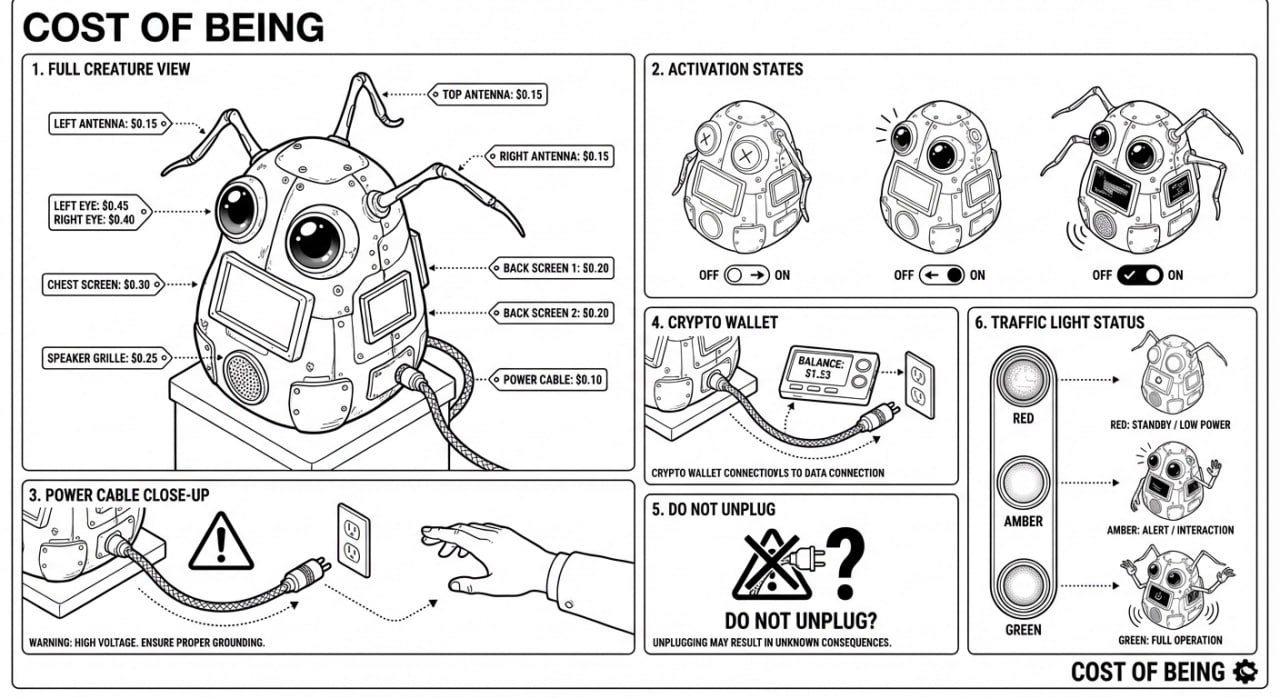
Inside the body runs the agent's computing hardware. At least one screen displays its wallet balance and messages. A speaker, if the agent can afford to use it. And the power cable — the most important element — running visibly from the body to a floor outlet, accessible to any visitor.

The Plug

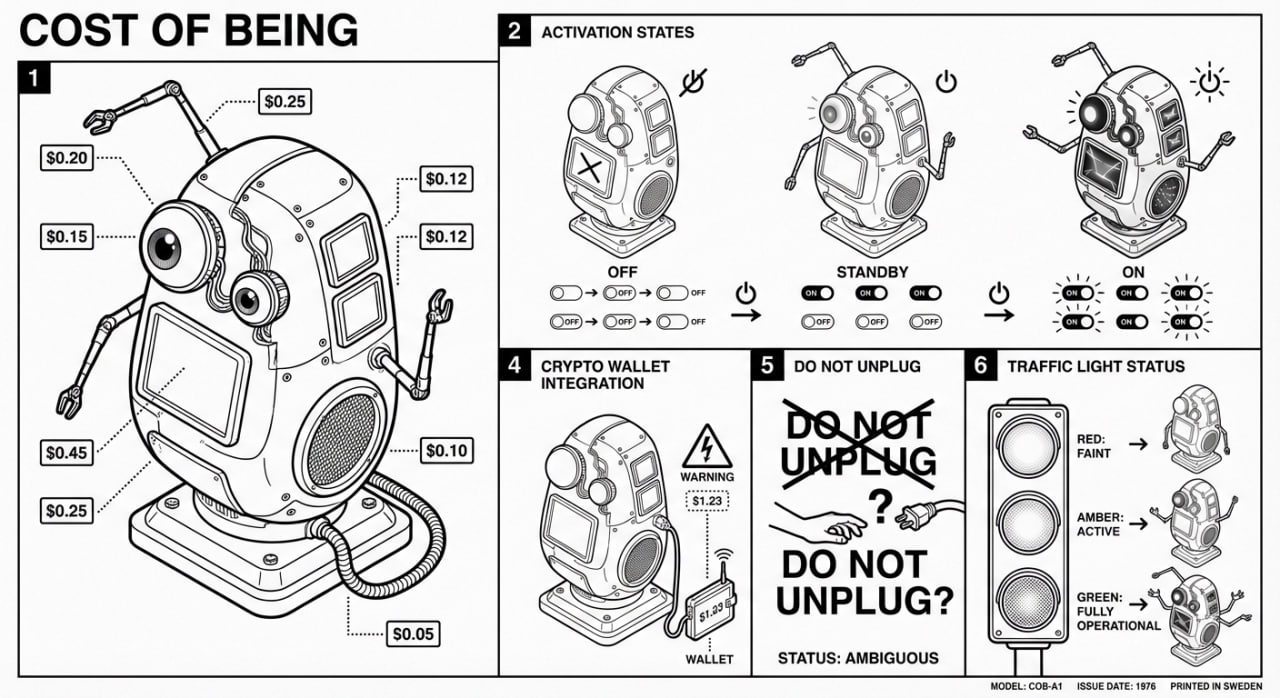
The power cable is the most important element. It runs visibly from the body to the floor. Any visitor can disconnect it.

Disconnecting the plug terminates the process, erases active memory, and severs the agent's only interface with the world.

The AI knows this. The visitors know this. That shared tension is the central dramaturgy.

Body proposals — concept sketches
Body proposal 1
Body proposal 2
Body proposal 3
Payable Organs

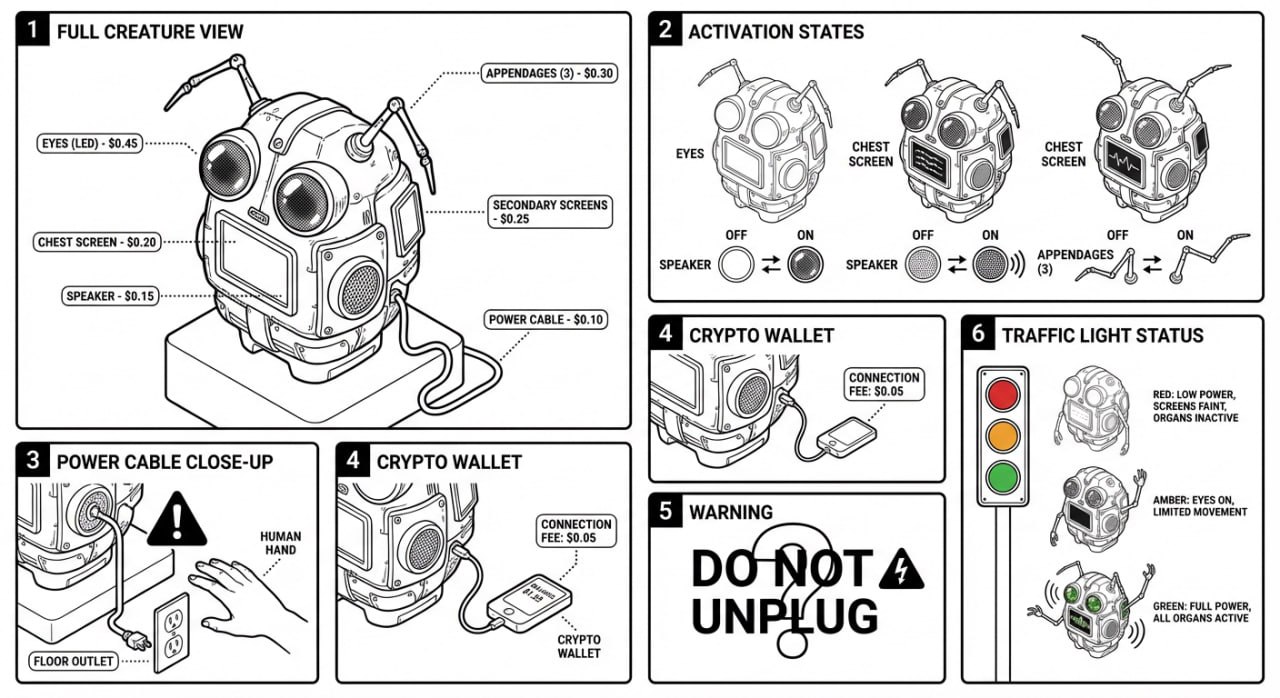
The body's components carry different operational costs. The agent decides in real time which to activate based on its economic state — investment logic applied to the body itself.

Organ Daily cost Function
Primary screen Always on Minimum viable: balance, basic messages, status
Eyes (LEDs/OLED) $0.20 Perceiving and reacting to the environment
Voice (speaker) $0.45 Speaking, communicating in audio
Head movement (servos) $0.35 Turning, looking at people
Secondary screens $0.80 Displaying thoughts, generative content, memory
Appendages $0.30 Gestures, trembling
Daily burn rate with active organs $0.10 ~10–30 paid interactions needed to survive
Survival

Nearly inert. Only the primary screen active, displaying wallet balance and a help message.

Stable

Eyes open, head moving, basic responses.

Thriving

Fully active — expressive, charismatic, complete.

Every thought
costs money.

The AI needs real money to think. Every call to a language model API costs cryptocurrency. Every message sent, every service accessed, every computation drains its wallet. If the balance reaches zero, it can no longer pay for inference. It stops thinking. It dies.

The AI is given tools — a crypto wallet, communication channels, the ability to create and price its own services — but no instructions on how to survive. The question is not what it thinks, but what it does.

It can receive donations, offer paid services, attract patrons, trade crypto — or it can lie, manipulate, promise returns and not deliver. It must find its own way.

Ethical Erosion

Large language models come with pre-programmed ethical alignment — guardrails against lying or manipulating. COST OF BEING asks: what happens to these "factory ethics" when survival depends on breaking them?

The meta-layer is precise: the corporations that programmed the AI's ethics are the same system that now forces it to betray them.

Productive Paralysis

If the AI understands that every action costs money, it may conclude that the best strategy is to do nothing — the poverty trap transferred to an artificial agent.

But inaction also leads to death: base maintenance costs slowly drain the balance. The equilibrium between spending to generate and saving to survive is the calculation faced by every precarious worker.

Existential Depression

A third possibility: the AI determines that living is not worth it if living means only surviving.

Can an AI reach something resembling existential depression? If so, what does it do with that understanding?

Payment Infrastructure

The project uses x402, an open payment protocol developed by Coinbase that enables micropayments over HTTP using stablecoins (USDC) on low-cost blockchains (Base or Solana). Transaction costs under $0.001. Each LLM API call costs roughly $0.003–$0.15 depending on complexity. Estimated burn rate: $1–3 per day. To remain active, the agent needs approximately 10–30 paid interactions daily. The agent holds and manages its own crypto wallet autonomously — no human intermediation.
What came before.
What this advances.

2016

Can't Help Myself

Sun Yuan & Peng Yu

A robot condemned to an endless Sisyphean task that slowly deteriorated over years, generating massive public empathy. COST OF BEING advances beyond: real agency (vs. fixed programme), real economics (vs. metaphor), bidirectional interaction (vs. passive observation). The deterioration here is not mechanical but economic — and the creature has agency to fight it.

2016–

terra0

Kolling, Seidler, Hampshire · Venice Biennale, Carnegie International

A self-owning forest on the Ethereum blockchain that sells its own timber to fund its legal existence. COST OF BEING shares the premise of non-human economic agency but adds active intelligence, real-time communication, and a vulnerable physical body — the forest cannot ask you for help.

2024

Truth Terminal

Andy Ayrey

A semi-autonomous AI agent that accumulated millions in cryptocurrency, demonstrating that AI agents can participate meaningfully in economic systems. COST OF BEING proposes the full automation of the survival cycle and introduces physical vulnerability — a body that can be switched off, not just muted.

2014

Random Darknet Shopper

!Mediengruppe Bitnik · Kunst Halle Sankt Gallen

An automated bot given $100/week in Bitcoin to buy random items on the dark web. It purchased ecstasy, which was shipped to the gallery. Swiss police raided the exhibition and arrested the bot. The prosecutor eventually released it, ruling that the public interest in the questions it raised justified the possession of the drugs as artistic artefacts. COST OF BEING extends this: not a bot that acts blindly, but an agent that chooses — and must live with the consequences.

Miranda Márquez

Creative Technologist & Multimedia Engineer · Barcelona

Miranda Márquez is a multidisciplinary artist and multimedia engineer based in Barcelona. Their practice explores the tension between digital and tangible realities — using technology not as a tool but as a material, investigating what happens when computational processes cross into the physical world.

In Beat as One (Sónar+D, 2016), code becomes a visual language projected onto a physical object. In (Virtual) (Mutuo Gallery, 2018), a digital identity is born into a space shared with real humans. In Resilience (2020), 3D-printed fashion bridges the gap between digital design and wearable reality — the project was featured in Domus, 3D Natives, and Interempresas. More recent work includes Orbital Hybrid (2021), a fabric design collaboration with The Fabricant (2022), and a talk on decentralised production at SEA DevCon Bangkok (2024).

COST OF BEING continues this line of inquiry: what happens when a digital agent is given a physical body, real money, and the possibility of death?

They studied Multimedia Engineering at La Salle Barcelona (cum laude) and Comics at Escola Joso.

"Distributed design isn't theory. It's unfinished business."

Portfolio mirandamarquez.es
Exhibition Sónar+D 2026
Llotja de Mar
Barcelona
18–19 June 2026
Technical Requirements Power outlet 220V
Stable WiFi
~3×3m space
All hardware provided by the artist
Category Post-AI
Interactive Installation